The promise of AI content was always "anyone can create." Prompt engineering broke that promise for most people. Templates are fixing it — and changing who wins in AI-assisted content creation.
For the first two years of the generative AI content boom, the dominant narrative was that prompt engineering was the skill that separated good AI output from great AI output. Learn to write better prompts, the advice went, and you'll get better results. Invest in prompt libraries. Study prompt patterns. Hire prompt engineers.
That narrative is collapsing — and not because prompt engineering doesn't work. It works fine. It's collapsing because it created a skill barrier that locked out the majority of creators, marketers, and business owners who were supposed to benefit most from AI content tools. The people who most needed fast, high-quality content output were the ones least likely to invest weeks learning a technical skill to access it.
Templates are solving this problem at scale. And the platforms that have built serious template libraries are pulling ahead of the ones still relying on users to figure out prompting themselves.
What Went Wrong With the Prompt Engineering Model
The core assumption behind prompt engineering as a user skill was that the complexity of getting good AI output should sit with the user. If your output is bad, your prompt is bad. Write a better prompt. Add more context. Specify the format. Define the tone. Describe the audience. Constrain the length.
This works — for people willing to invest the time. The problem is that the investment required is substantial and ongoing. Models change. What worked in one version underperforms in the next. Prompt patterns that produced strong results six months ago produce mediocre ones today. For creators and entrepreneurs whose primary job is not AI content production, this creates a maintenance burden that makes the tools less useful over time, not more.
"The people who most needed AI content tools were stopped at the door by the complexity of using them."
The result was a predictable stratification: a small group of technically proficient users who got excellent results, and a large majority who got inconsistent results and gradually used the tools less. The market responded.
What Templates Actually Are (and Aren't)
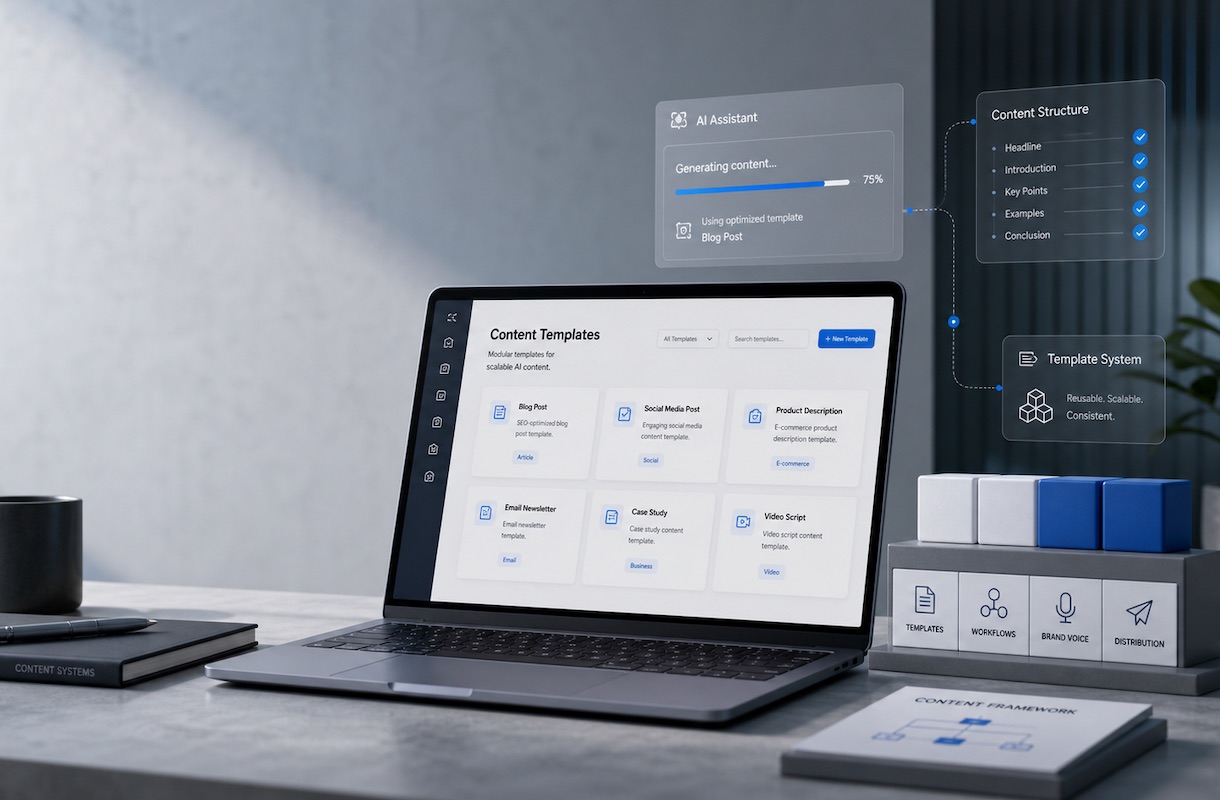
The word "template" undersells what the best AI content templates are doing. A basic template is a saved prompt with blanks to fill in. That's table stakes and barely better than writing the prompt yourself.
A well-engineered AI content template is something more sophisticated: a pre-tested prompt system that encodes format requirements, output constraints, tone parameters, and platform-specific optimisations — built and iterated by people who have already done the testing to find what produces the strongest results for that specific content type.
What a good template encodes
The expertise that used to live in your prompt
Format: the output structure that performs best for this content type on this platform. Constraints: length, tone, reading level, sentence structure. Context: what the model needs to know about audience and intent to generate relevant output. Optimisations: the specific instructions that prevent the most common failure modes for this content type. A creator selecting an Instagram Reel caption template isn't filling in a form — they're accessing the output of dozens of tested iterations, pre-baked into a single selection.
The practical difference in output quality between a well-engineered template and a user-written prompt for the same task is significant — and consistent. Templates don't have off days. They don't forget to specify the tone or the audience. They encode best practice every time, which means the output floor is much higher even when the ceiling is slightly lower than what an expert prompt engineer might achieve manually.
The Shift in Who's Winning at AI Content
Eighteen months ago, the creators and marketers producing the best AI content were the ones with the deepest prompt engineering skills. That correlation is weakening fast.
The creators gaining ground most rapidly in 2026 are the ones on platforms with the strongest template libraries — because templates compress the skill gap between expert and non-expert users to near zero for most content types. A creator with no prompt engineering knowledge using a well-built template produces output that competes directly with an expert user writing prompts manually. The template absorbs the expertise.
Prompt engineering model
- High skill barrier to entry
- Inconsistent output quality
- Maintenance burden as models update
- Time investment ongoing
- Expertise non-transferable
Template model
- Near-zero skill barrier
- Consistent output floor
- Templates maintained by platform
- Select and generate in seconds
- Expertise shared across all users
Where Templates Are Strongest — and Where They Still Fall Short
Templates perform best where content requirements are well-defined and repeatable. Social media captions, video scripts, ad copy, product descriptions, email subject lines, Reel hooks — these formats have known constraints, known performance patterns, and known failure modes. A good template encodes all of that. The output is strong, consistent, and fast.
Templates perform less well where the creative requirement is genuinely open-ended or highly idiosyncratic. Long-form brand storytelling, strategy documents, highly personal narrative content — these still benefit from human direction at the prompt level. But these content types represent a small fraction of the volume most creators and marketers actually need to produce weekly.
For the 80% of content that is format-defined and repeatable, templates have effectively solved the prompt engineering problem. The remaining 20% still rewards prompt skill — but that's a manageable scope for most users to develop, rather than the universal requirement it was positioned as two years ago.
What the Best Template Libraries Look Like in Practice
Not all template libraries are equal. The difference between a surface-level template library and a genuinely useful one comes down to three things: specificity, testing, and maintenance.
Specificity
A template labelled "social media caption" is too broad to be useful. A template labelled "Instagram Reel hook — contradiction format — product reveal" is specific enough to consistently produce strong output. The best template libraries are built around the specific content jobs creators actually need done, not broad categories that still require significant user judgment to apply.
Testing
The value of a template is entirely dependent on whether it has been tested against real content requirements and real model outputs. Untested templates are saved prompts with a label. Tested templates are encoded best practice. The platforms investing seriously in template quality are running hundreds of iterations per content type before shipping — and the output quality difference is immediately apparent.
Maintenance
AI models change. A template that produced excellent output with one model version may underperform with the next. Platform-maintained templates are updated as models change, without any action required from the user. User-maintained prompt libraries are not — and the degradation in output quality as models update is one of the less-discussed costs of the prompt engineering model.
The Platform Implications
The shift from prompt engineering to templates has significant implications for which AI content platforms are worth using. A platform with strong individual model access but a weak template library is increasingly at a disadvantage compared to a platform with a deep, well-maintained template library — even if the underlying models are comparable.
This is where consolidated platforms that have invested in creator-specific templates are pulling ahead. When a no-prompt AI image generator ships with pre-built templates for Instagram square, Reel background, product mockup, and ad creative — all tested and optimised — it eliminates the primary barrier between the user and useful output. The same logic applies across video, audio, and writing.
Platforms like glown.ai are built explicitly around this model — creator templates across image, video, music, and text generation, designed so users select a format and generate without writing a prompt. The template encodes everything the model needs; the user provides the content-specific variables. This is the direction the market is moving, and the platforms that understood it earliest have the strongest template libraries today.
What This Means for Content Velocity
The most concrete consequence of the template shift is speed. A creator using well-built templates produces content significantly faster than one writing prompts manually — not because the template is cutting corners, but because the deliberation and iteration that prompt writing requires is replaced by selection and customisation.
| Content type | Manual prompt time | Template time | Velocity gain |
|---|---|---|---|
| Instagram caption (5 variations) | 12 min | 2 min | 6× |
| AI product image (4 variations) | 15 min | 3 min | 5× |
| Short-form video clip | 20 min | 5 min | 4× |
| Video background track | 8 min | 1 min | 8× |
| Email subject lines (10) | 10 min | 2 min | 5× |
Multiplied across a weekly content workflow, the velocity gain from templates compounds into a substantial operational advantage. A creator producing the same volume of content in one-fifth the time has four-fifths of their content production time available for distribution, engagement, and strategy — the activities that actually build an audience.
The Template Skill That Still Matters
Templates don't eliminate creative judgment — they relocate it. Instead of applying judgment at the prompt level, users apply it at the template selection level and the output editing level. Which template fits this specific content job? Which of the generated variations is strongest? What specific edit makes the output more on-brand?
These are faster, lower-friction decisions than prompt writing — but they're still decisions that require content judgment. The creator who understands their audience and their content goals will always outperform the one who selects templates randomly. Templates lower the floor of AI content quality; human judgment raises the ceiling.
"Templates make the baseline excellent. Judgment makes it exceptional. You still need both — but the ratio has shifted dramatically in favour of judgment."
The practical skill worth developing in 2026 is not prompt engineering. It's template literacy — understanding which templates exist for which content jobs, how to customise them for brand-specific requirements, and how to evaluate output quality quickly. That skill is transferable across platforms, requires no technical knowledge, and compounds in value as template libraries grow.
For creators building this skill, the guide to creator-favourite AI tools 2026 covers the platforms with the strongest template libraries across every content format. And for anyone still managing separate subscriptions for image, AI video creation, AI music creation, and AI writing for creators — consolidating into one platform with a unified template library is where the real productivity gain lives. The all-in-one AI subscription model makes this straightforward to evaluate.